What Are AI Builds? A Plain-English Guide
You already know what an app is. An AI build is the same idea, but for your Muse: a reusable package that teaches it how to do one specific thing well — booking flights, reviewing code, planning meals, tracking workouts.
Instead of explaining the task from scratch every time, you install the build once. From then on, your Muse just knows how.
Builds vs. apps vs. prompts
- An app is a program you open. It has buttons, screens, its own world.
- A prompt is a one-off instruction you type. It works once, then it is gone.
- A build lives inside your Muse. It combines instructions, examples, and sometimes code, so your Muse can repeat the task reliably — in any conversation.
Think of it this way: a prompt is a sticky note, an app is a toolbox, and a build is teaching your Muse a trade.
What is inside a build?
Most builds contain some mix of:
- Instructions — how your Muse should approach the task, step by step.
- Examples — sample conversations showing the task done right.
- Code or integrations — for builds that need to call APIs, run scripts, or fetch live data.
- A description — what the build does, which platforms it supports, and who made it.
The four kinds of builds, in one line each
- A skill — a reusable instruction pack (often a single SKILL.md file) that turns your Muse into a specialist for one job.
- An app — a ready-made program, with its own screens, that works with or alongside your Muse.
- A connector — a bridge that plugs your Muse into an outside service — email, calendar, payments — so it can act there for you.
- A prompt pack — a bundle of ready-made prompts you pull out when you need them; nothing new stays installed.
Where do builds live?
Builds are platform-specific. A build made for one assistant does not automatically work in another — each assistant has its own format. Before installing anything, check the build's listing for the platforms it supports.
You may know these as "Claude skills" — they use the same open SKILL.md format, and they install in Muse the same way.
That is exactly what a directory is for: Skill Harbor's listings show each build's supported platforms, price, and verification status up front, so you do not discover incompatibilities after you have paid. Today, every listing on Skill Harbor works with Muse — we're opening the directory to other personal assistants soon.
What can builds actually do?
Real examples from the directory:
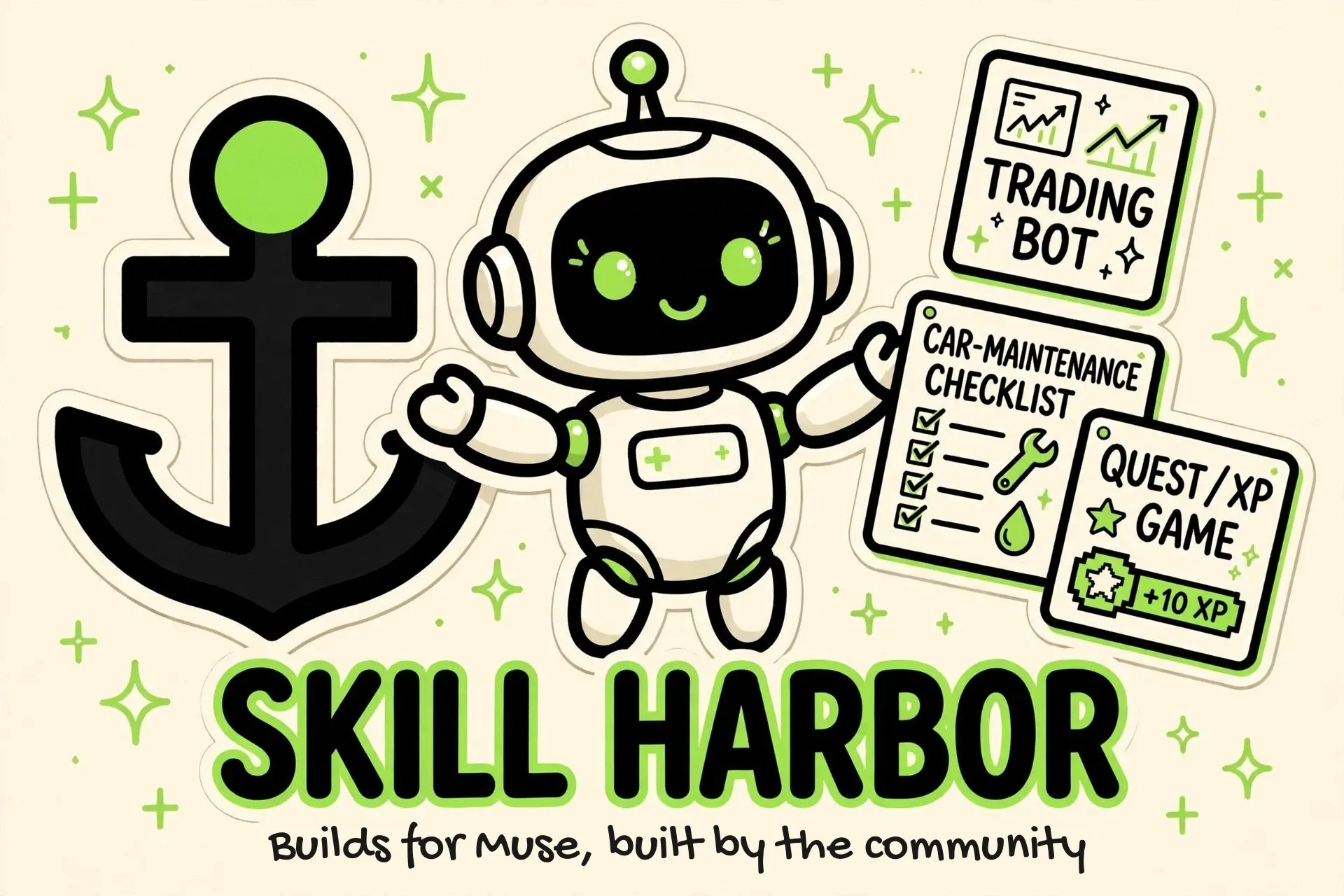
- Run a website's back office — moderation, publishing, reporting — from a chat conversation.
- Track car maintenance and remind you before the next oil change.
- Turn a to-do list into a game with XP, streaks, and weekly bosses.
- Paper-trade stocks with a bot that follows your strategy while you sleep.
How much do builds cost?
Many builds are free, especially open-source ones. Paid builds usually charge a one-time fee or a small subscription — and you always pay the seller directly, never the directory. On Skill Harbor, listing a build is free, and creator verification is free too.
Frequently asked questions
- What is an AI build?
- A reusable package — instructions, examples, and sometimes code — that teaches your Muse how to do a specific task well.
- Are AI builds the same as apps?
- No. An app is a standalone program you open. A build plugs into your Muse and extends what it can do in conversation.
- Are AI builds free?
- Many are, especially open-source ones. Some authors charge a one-time fee or subscription.
- Do AI builds work with ChatGPT, Claude, and others?
- It depends on the build in general — each assistant has its own build format. On Skill Harbor, every build works with Muse today; we're opening the directory to other personal assistants soon.